SimClusters means we’re all living in the influencer dimension now https://dl.acm.org/doi/10.1145/3394486.3403370
if you're in the top 10,000,000 of twitter users, you count as an "influencer". if you're one of the other 990,000,000, you're basically a tweet pic.twitter.com/gYdH3ejbZU
— space cat - b/acc (@cat_upgrades) September 26, 2020
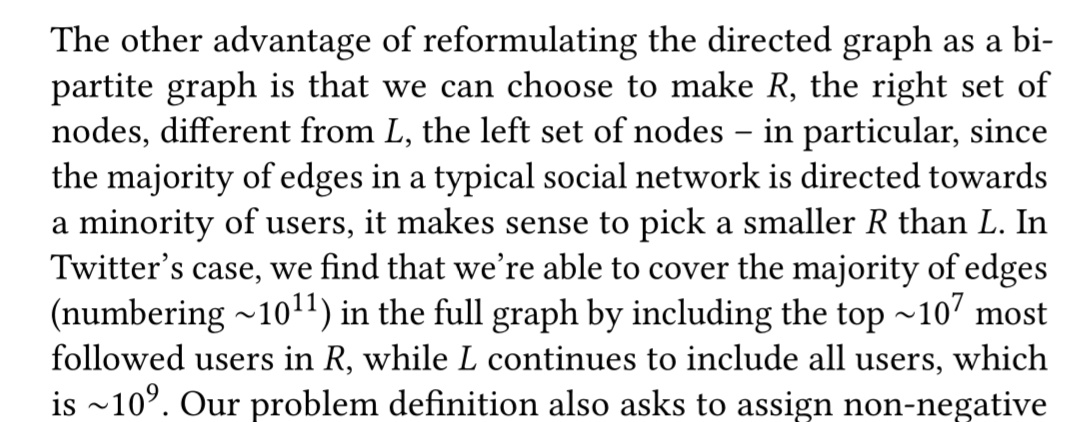
Basically, Twitter uses a latent space of simulated “communities” as the topology of the network. The top 1% of users are considered “influencers.” If a group of influencers have a lot of shared incoming connections, they become a “community.”
These simulated clusters go on a gigantic sparse matrix with all types of content: users, tweets, hashtags, “Events.” This way they can use nearest-neighbor analysis rather than heavy matrix multiplications, as well as representing all content in the same latent space.
All users can belong to one or more of these communities, and so can all tweets. Influencers can change the shape of these communities through their actions, but only indirectly: attracting or repelling different followers. If you’re not an influencer, you’re basically a tweet.
Oh, that’s right in the linked post, lol.
This is very reminiscent of Twitterverse graphs, I think.